
The universities in Borås and Skövde strengthen Wexsus
It has now been confirmed that the University of Borås and the University of Skövde are joining Wexsus, which is already jointly led by Chalmers University of Technology, the University of Gothenburg and University West. With five higher education institutions now part of the initiative, Wexsus is emerging as one of Sweden’s strongest academic collaboration hubs for sustainability development, with the capacity to bring together knowledge, perspectives and partners from across West Sweden.
Wexsus aims to facilitate collaboration and partnerships for sustainable development between higher education institutions in West Sweden and other sectors of society. The University of Borås and the University of Skövde are now joining Wexsus and taking seats on its steering group. Through this broaded leadership structure, Wexsus will be better positioned to bring together knowledge, perspectives and stakeholders for sustainable transition, with stronger regional and national impact.
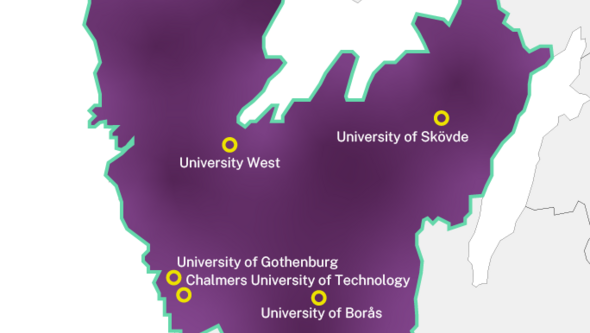
With this, the steering group of Wexsus will gain two new representatives.
The University of Skövde will be represented by Tehseen Aslam, Deputy Vice-Chancellor for collaboration. He highlights the university’s long-standing work on digitalisation for sustainable development as an important contribution to the partnership.
– Over many years, the University of Skövde has developed a strong profile in digitalisation for sustainable development. It is a strength that runs throughout the entire university and one that we are now bringing into Wexsus. We look forward to collaborating within Wexsus to contribute to the ongoing societal transition, says Tehseen Aslam.
The University of Borås will be represented by Anders Stenström, Head of Research and Innovation. He emphasises the importance of cross-sector collaboration and sees Wexsus as an important platform for connecting higher education institutions and societal stakeholders around sustainable development.
– Through our strong research and innovation in areas like textiles and fashion, resource recovery, healthcare, library and information science, and AI, we already work closely with industry, the public sector and civil society. Wexsus will provide an important arena for connecting these perspectives with other higher education institutions and societal stakeholders in the region. Achieving the transition to a more sustainable society requires collaboration that crosses organisational and academic boundaries. We therefore see Wexsus as an opportunity to jointly develop new knowledge, strengthen innovation and create approaches with real-world impact, says Anders Stenström.
Wexsus is organised as a shared collaboration hub between academia, industry, the public sector and civil society. The dual mission of higher education institutions – to engage with society and to promote sustainable development – forms the foundation of the five universities’ activities within Wexsus.
Several key stakeholders are already part of the partnership, including the Västra Götaland Region, which co-founded Wexsus and also holds a seat in the steering group, as well as the County Administrative Board of Västra Götaland.
Municipalities and municipal federations are also important collaborative partners, and so far the City of Trollhättan and the Gothenburg Region Association of Local Authorities have become associate partners of Wexsus. The five higher education institutions in West Sweden will now continue to build strategic collaboration with societal stakeholders in order to contribute jointly to a sustainable transition.