
Hello Priscilla Cubo, recently returned from COP30 in Belém
Priscilla Cubo is an advisor at Sida's helpdesk for the environment and climate, an operation within Wexsus. She also has extensive experience in human rights issues from the civil society sector and she comes from Brazil. During the first week of COP30 in Belém, Priscilla was on site to monitor issues of the environment, climate and development for Sida's helpdesk and Wexsus.
Hello Priscilla Cubo! What was your official role at COP30?
Observer for Sida’s Helpdesk for Environment and Climate, with accreditation from the University of Gothenburg. I had access to both the Blue and Green Zones, but no speaking rights in the decision meetings.
What are your most important insights and what did you learn?
It reinforced what I already believe: that all these issues – climate, sustainability, and human rights – must be grounded in a perspective that puts the rights of people and nature at the center. Not everything in the world can or should be monetized. The care that the Amazon and local communities give to biodiversity cannot be priced. You cannot put a price on it.
What did you do during COP30?
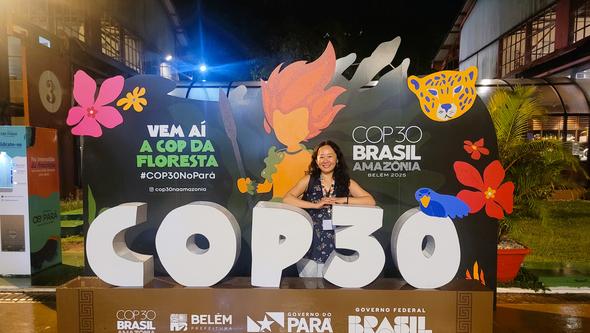
I was there for a week and attended at least three seminars or workshops per day, plus cultural events. It was very intense, with an incredible number of parallel sessions, so I put together a schedule for myself for the first week, which was the week I had accreditation for. I took part in many seminars in the Blue and Green Zones, in the agriculture area outside the conference venue, and at the People’s Summit together with civil society and Indigenous representatives.
What was it like on site?
There were many difficult but very rich conversations and discussions. It was intense, exciting, and sometimes overwhelming. It was also extremely hot, which was physically exhausting but also symbolically heavy.
The discussions were on a high level – so many informed and knowledgeable people – and provided important updates on what is happening in the world. It was inspiring to see Indigenous representatives and Brazilian actors participate in the conversations, together with international organizations that gave significant space to local voices.
Who did you meet?
Many like-minded people who organize around human rights and collective interests. I also saw many lobbyists and people focused on profits, mining deals, and oil negotiations but I chose to avoid their events and did not interact with them.
The Swedish pavilion was strongly business-oriented; I would have liked to see more perspectives represented. There were many good discussions about Sida’s work in developing countries, but the overall focus was on companies, which reflects the current Swedish political context.
What made the strongest impression that you will remember for a long time?
I attended a seminar on carbon markets and emission offsets, markets where one country pays for emissions while another gets paid to, for example, preserve forests. An Indigenous representative gave a five-minute presentation that became a key message for me: new climate solutions often restrict Indigenous lands, yet the Indigenous peoples themselves are not included. The new carbon market, which is supposed to be the new solution, could take their land away from them – even though they are the solution. They have cared for the forests and rivers for generations.
Holding COP in the heart of the Amazon also felt significant. This place rarely receives international attention. I hope it made a strong impression on the world.
Would you do it again, for example next time when it’s in Turkey?
I have chosen not to attend some previous COPs because of too many restrictions on civil society organizations and on human rights issues. If such problems are repeated, I will not go again. But if civil society is welcomed, I would gladly go. It is an incredibly valuable experience.
Do you think COP is an effective way to act against climate change?
The negotiations are enormous, the level of ambition is high, but many of the targets are not achievable. I attended a seminar on Article 6, which deals with carbon markets. For a country to participate in these markets, it must meet certain national requirements, but at the moment no country fulfills them. Not even Sweden’s own climate fund has reached its goals, and more financing is needed. The ambitions are too high and the goals are not realistic.
You’re from Brazil but did you have any previous connection to Belém?
I have a friend from a student exchange in Spain whom I reconnected with. She is from Belém and lives very close to the conference area. I was able to stay with her during COP30. It was extremely difficult to find accommodation, so I was very lucky and incredibly grateful to be able to stay with her.
COP30 is the 30th Conference of the Parties (COP), an annual global meeting where world leaders, scientists, NGOs and civil society leaders gather to discuss measures to tackle climate change.